
Hello. This is the first post of the Pizia devlog, a thing we’ve been saying we would start “next month” for approximately three years. I’m Santiago, I write code here together with Martin. Quick rule for reading this blog: if something in the game moves, that was me or Martin. If something looks beautiful, that was Ezequiel. If something is broken, Martin and me have a very mature system where it’s always the other one’s fault.
For the people that never heard of us: Pizia is a small game studio from Córdoba, Argentina, and for a while now our entire life is a game called Hayaku! Island of Darkness. It’s a 2D action metroidvania where you explore an island, uncover the darkness that infected it, punch an unreasonable amount of robots, and drive mechas. You can wishlist it on Steam, which I will mention again at the end because I have no shame.
If you did hear of us, it’s probably because you follow Ezequiel on Twitter, where the game has been appearing as beautiful GIFs since years. Maybe you even played one of the public demos at an event. In that case you may be wondering why a game you personally held in your hands is getting an “announcement” post in 2026.
Good question. Sit down, this is a story.
The game Ezequiel made when nobody was looking
Hayaku! did not start as a studio project. Ezequiel made it alone, in his free time, in an engine called Construct 3. He drew every sprite, animated every frame and wired every mechanic himself, for fun. Then it stopped being small. At some point “my little platformer” had a whole island, a mecha with interchangeable parts, a shop, and a cast of characters with more personality than most people I know. So he brought it to the studio, and we said the only reasonable thing: okay, this is the game now. It went to events, people played the demos, people came back to play again. It was the thing. THE thing.
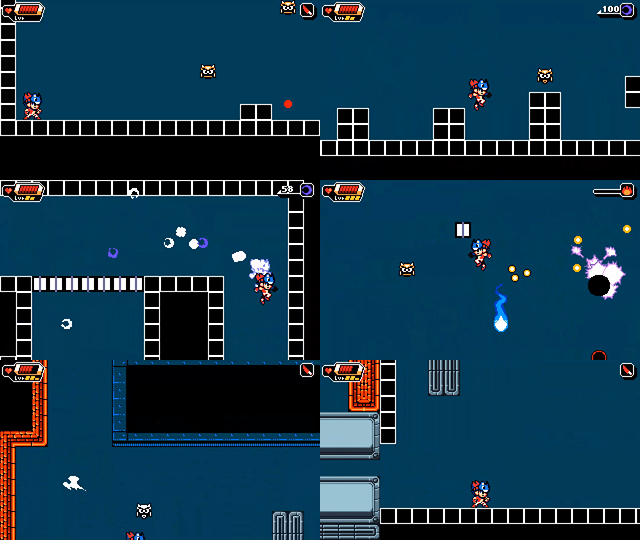
Now, Construct 3 is a great tool, and I want to say it clearly before the jokes start (or, actually, before people start getting offended): Hayaku exists because an artist with almost no programming background (but a heart of gold) could build a whole metroidvania in it, alone. But Construct works with event sheets, a kind of visual programming, and at our size they had become something I can only describe as a crime scene. Hundreds of sheets. Invisible sprites doing load-bearing work. Logic that made perfect sense to one person at 3am years ago, and that person doesn’t remember either. Every new feature took longer than the last one. When people at Pizia started to help him, they said “we should migrate to javascript”. And they did. Kinda. Other people said “We should do typescript”. And they did. Kinda. By the end of 2025 it was obvious, and we took the decision every developer fears in public and secretly dreams about: port the whole game to another engine. With our expertise, that choice made itself: Unity.
This may be a cliche, but I mean it sincerely: it’s not you, Construct. It’s us. We got big. We asked for stuff that you weren’t meant to give us. I will still recommend you every single time. For the appropriate projects, anyway,
How to make the same game twice
The first Unity commit is from November 10, 2025. Since then, Martin and me have made around 1,700 commits, of which at least thirty are called “fix” and one is called “fix fix”. Martin says that one was me. The git history says it was Martin. The git history has never lied to me.
Here’s what nobody tells you about porting a game: the code is not the hard part. The feel is.
Hayaku’s whole identity is how it moves. The name literally means “hurry” in Japanese. That feel lived inside Construct’s exact gravity, its exact acceleration curves, its exact frame timing, and none of that comes with you when you leave. You get the sprites, the ideas, and an empty engine that moves like a stranger.
I said, out loud, with my whole chest, “a jump is a parabola, how hard can it be.” Martin, who is the prudent half of this programming team, said nothing, which I should have taken as the warning it was. We rebuilt the movement system I honestly don’t remember how many times. Gravity curves, jump arcs, how the dash cuts through everything. One jump costed us weeks. And our quality control was not a spreadsheet, it was Ezequiel: he would take the controller, do two jumps and one dash, hand it back and say “it’s not the same.” He could never explain why. He was always right. Being debugged by vibes is the most irritating and most useful thing that has happened to me as a programmer.
The other half of the job was archaeology. To port a mechanic, first you have to discover how it actually worked, which means reading event sheets from years ago like ancient scrolls. They should just hand me a geology major or something. I’ve done my time! Some mechanics we ported. Some we understood first and ported after. Some, we had to port to understand. At least I hope we did.
Okay, but is it the same game?
No. It’s better, and I say this with the confidence of a man whose artist now does his two jumps and one dash and just nods.
That was the deal from day one: the game comes back feeling right or the whole port was pointless. What we didn’t expect is what happens after. Once we stopped fighting the project, nine months of pent-up “wouldn’t it be nice if” came out all at once:
The island got a transit system. A fast travel network, because the island kept growing and your legs are only two.
New toys. Weapons and abilities that never existed in the old demos. I’ll only say one of them is a drill that grapples to ceilings and lets you swing like an idiot, and it’s currently my favorite thing in the game. Also there are bombs now. Everything is better with bombs.
New faces that want to kill you. The enemy roster grew and the old ones got meaner. Ezequiel keeps drawing new ways to die, we keep programming them, nobody questions the arrangement.
The game can lie about what machine it’s running on. Display filters that make it look like a CRT, scanlines and all, or like a Game Boy, that green kind of nostalgia. We spent an amount of time on these that no reasonable producer would approve. We don’t have a producer. Should we get a producer?
And if you played a demo and you’re thinking of a specific weapon or mode I didn’t mention: it’s (probably) not gone, it’s in the queue. We refuse to bring a piece back until it’s at least as good as you remember it. The irony of a game called Hurry being remade this carefully is not lost on anyone here.
The part where I answer the question you’re already typing
When does it come out? I read this question in your voice and I felt it in my body. Thing is, if I write a date here, some future version of me has to honor that date, and it is my job to protect that guy. So the answer has to be: When it’s ready. Wishlisting is, coincidentally, the best way to make the waiting productive.
How often will you post here? I won’t promise a schedule, because… well, because I’ve met us. But posts ARE coming: one about the tools we built to survive the port, and Ezequiel keeps threatening to write about the art, which you should want. I mean… You ARE following him, aren’t you?
The shameless part
I told you it was coming.
If any of this sounded good, wishlist Hayaku: Island of Darkness on Steam. It helps more than any other single thing, and it costs you one click and zero regrets. If you want to see the game move instead of reading me describe it, Ezequiel posts GIFs that are better than anything I wrote here. And if you want to watch us slowly lose our minds in real time, the Discord is open.
Thank you Ezequiel, and Martin, who read this before you did and only corrected the technical parts, which tells you everything about the rest.
Thank you to everyone else at Pizia, past and present, and everyone not at Pizia as well, who helped carry this thing. You know who you are.
And thank YOU for supporting us and for reading the first one. More ahead.